Licks from the Source · Vol. 3
Wynton Kelly's Minor ii-V-i Lick on "Fifth House" | Licks from the Source, Vol. 3
Wynton Kelly on “Fifth House” ·
Why this lick
Wynton Kelly's piano solo on John Coltrane's "Fifth House," from the album Coltrane Jazz, opens with a clear, swinging line over a minor ii-V-i in F minor. This lick is the opening of his solo (2:26 to 2:29 on the recording). In just a few beats, he moves through the ii and V with a chromatic descent and resolves cleanly into the i chord. "Fifth House" is based on the changes to "What Is This Thing Called Love," so this lick works there too. It's a great piece of minor ii-V-i vocabulary, and it can be adapted to other ii-V's.
The original lick
Here's what Wynton is doing, chord by chord:
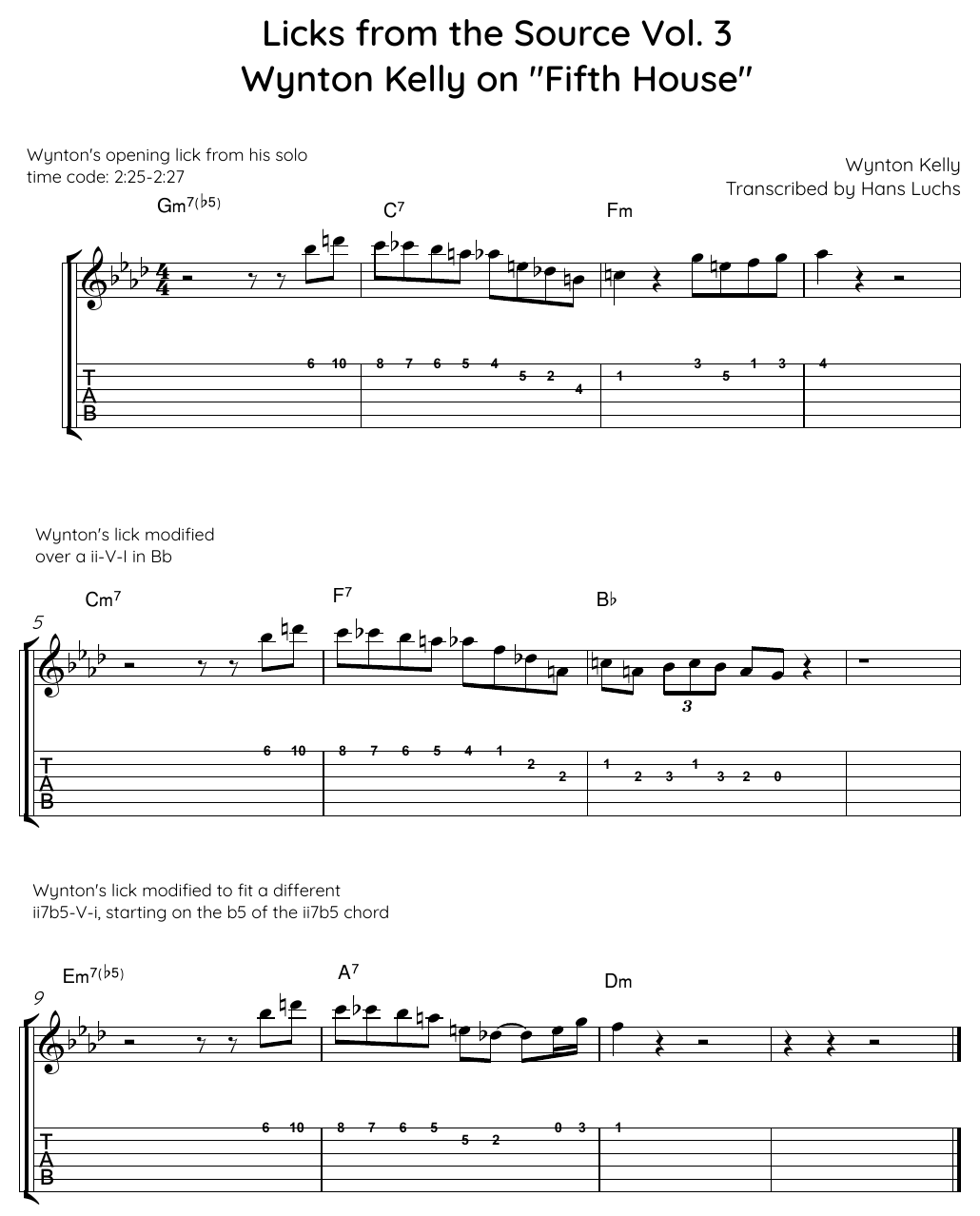
Over Gmin7(♭5): a pickup of B♭ and D. These two notes form an enclosure around C, approaching it from below and above, so the line lands right on C, the root of C7, at the start of the next bar. Wynton's D natural is a bit of an unusual choice here, since Gmin7(♭5) has a D♭. Because of that D natural, the lick would also work very well over a regular Gmin7.
Over C7: a chromatic descent from C down through B, B♭, A, and A♭. Then E, the 3rd of C7, followed by D♭ and B natural, a second enclosure that surrounds C from above and below.
Into Fmin: the line lands on C, the 5th of the chord, then plays a third enclosure: G and E surround F, the root, from above and below. From there, the line moves up through G to A♭, the 3rd.
So the lick uses three enclosures: two targeting C, leading into C7 and into Fmin, and one targeting F, the root of Fmin.
The tab shows one way to play it, but the lick can be played in a few different positions on the neck. Try finding it in other spots, and use whichever fingering feels most natural to you.
Two ways to stretch it
Once you know the original, you can adapt it to other situations. The notation above includes two variations.
1. Over a major ii-V-I in B♭. Wynton's lick modified to fit Cmin7, F7, and B♭. The opening stays the same, and the ending changes to resolve into a major chord instead of minor.
2. Over a different minor ii-V-i. Wynton's lick modified to fit Emin7(♭5), A7, and Dmin, starting on the ♭5 of the ii chord. The pickup notes are the same, but here the B♭ becomes the ♭5 of Emin7(♭5), which leads the line into a new key.
How to practice it
Listen first. Try singing along with the recording before playing it on your instrument. Then you can pick up the guitar and sing while you play it.
Learn it slowly. You can start by practicing it under tempo, then bringing it up to speed.
Take it through all 12 keys. Or, at least find a 2nd or 3rd position to play it on the guitar.
Use it in tunes. Find minor ii-V-i's in a standard you're working on and drop the lick in.
Make it yours. You can tweak a few notes or rhythms, or find some new harmonies to play it over. Try to make it sound like something you'd naturally play yourself.
In the video, I play through the original lick and each variation, and talk about how I'd use them in my own playing.


