Licks from the Source · Vol. 1
Freddie Hubbard's ii-V-I Lick on "Dolphin Dance" | Licks from the Source, Vol. 1
Freddie Hubbard on “Dolphin Dance” ·
Why this lick
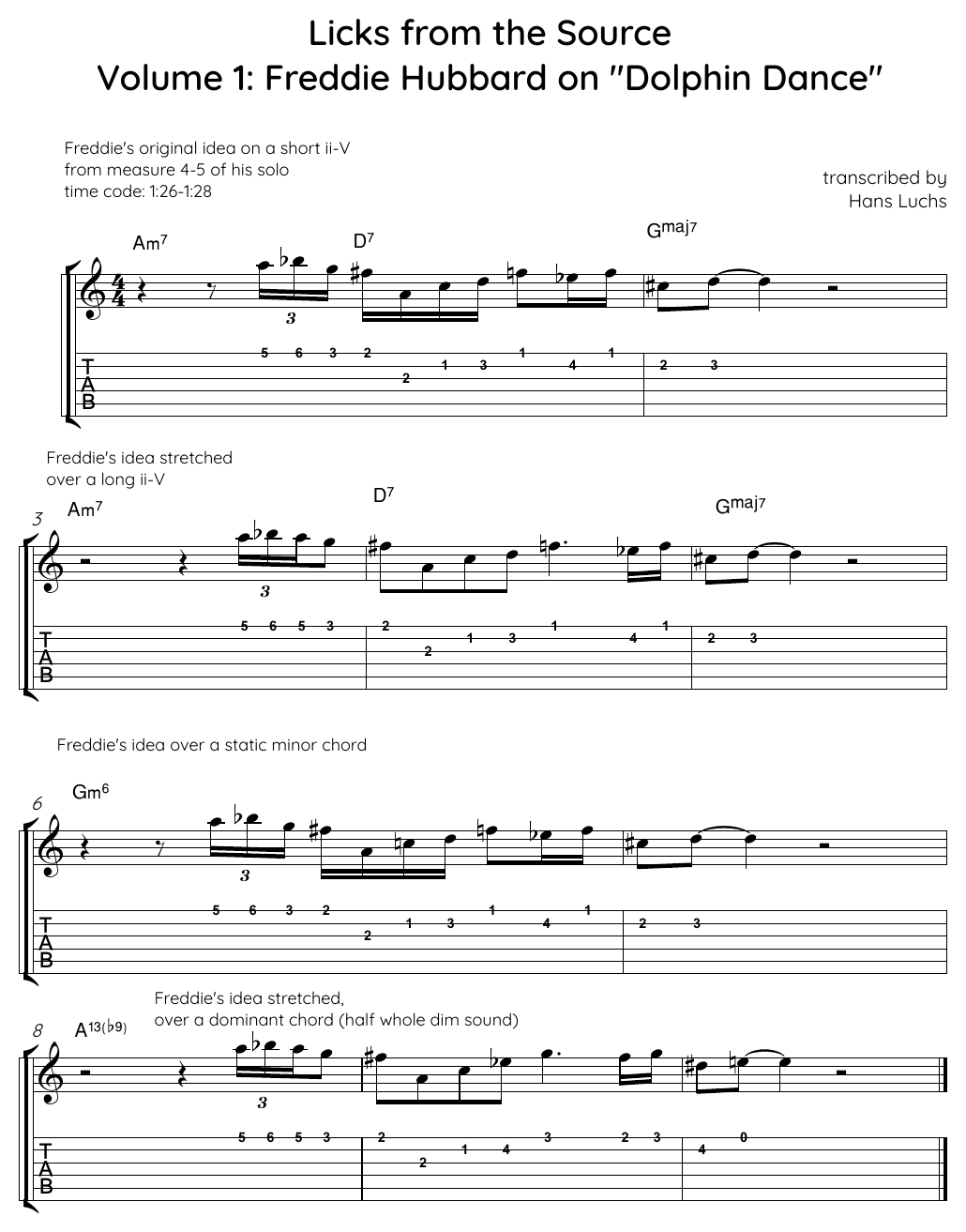
Freddie Hubbard's solo on Herbie Hancock's "Dolphin Dance" is a great example of how to approach this challenging tune. This lick comes from measures 4 and 5 of his solo (1:26 to 1:28 on the recording). In just a few beats, he plays through a ii-V-I with a chromatic twist, some altered tension on the dominant, and a smooth resolution. This flexible lick can be utilized in several other contexts besides the original.
The original lick
Here's what Freddie is doing, chord by chord:
Over Amin7: a quick triplet of A, B♭, and G. The B♭ is a chromatic neighbor that gives the line its slippery start before landing on the 7th of the chord.
Over D7: he begins on F♯, the 3rd, and outlines the chord with F♯, A, C, and D. Then he adds tension with F and E♭, the ♯9 and ♭9 of D7.
Into Gmaj7: the line resolves through C♯ to D, a chromatic approach to the 5th of the chord.
The ii-V here (Amin7-D7) can really just be thought of as V. Therefore, the whole lick becomes a V-I resolution. This is how the great educator (and pianist) Barry Harris would've approached it.
The tab shows one way to play it, mostly on the top three strings, but the lick can be played in a few different positions on the neck. Try finding it in other spots, and use whichever fingering feels most natural to you.
Three ways to stretch it
Once you know the original, you can bend it to fit other situations. The notation above includes three variations.
1. Over a long ii-V. The same idea, spread across a full bar of Amin7 and a full bar of D7. Lengthening a few notes makes room for the line to breathe, which is useful for tunes with slower-moving harmony.
2. Over a static minor chord (Gmin6). This lick works over a static minor chord, such as Gmin6. Even though the harmony doesn't move, I hear the line as an implied V7-i: the middle of the line outlines D7, with the F and E♭ as its altered tensions, and the end resolves back into Gmin6. It's a useful way to create motion over a chord that sits for a while.
3. Over a dominant chord (A13♭9). Here the idea is stretched over A13♭9, with a few notes changed so the line fits the A half-whole diminished scale. It's a great way to bring this sound into any dominant chord where you want more tension.
How to practice it
Listen first. Try singing along with the recording before playing it on your instrument. Then you can pick up the guitar and sing while you play it.
Learn it slowly. You can start by practicing it under tempo, then bringing it up to speed.
Take it through all 12 keys. Or, at least find a 2nd or 3rd position to play it on the guitar.
Use it in tunes. Find ii-V-Is in a standard you're working on and drop the lick in.
Make it yours. You can tweak a few notes or rhythms, or find some new harmonies to play it over. Try to make it sound like something you'd naturally play yourself.
In the video, I play through the original lick and each variation, and talk about how I'd use them in my own playing.