Licks from the Source · Vol. 2
Bud Powell's Rhythm Changes Lick on "Bud's Bubble" | Licks from the Source, Vol. 2
Bud Powell on “Bud's Bubble” ·
Why this lick
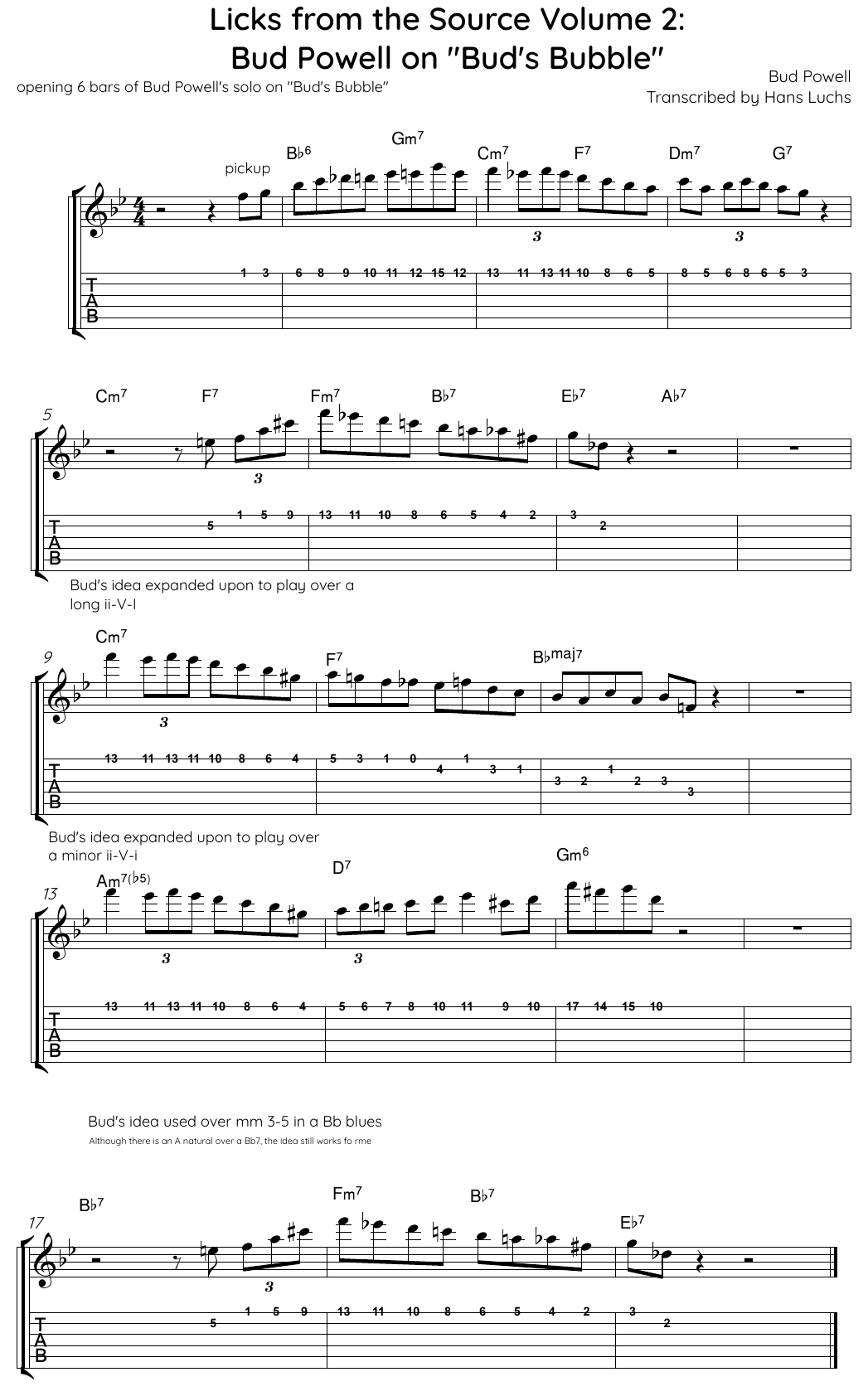
Bud Powell's solo on his own tune "Bud's Bubble" is full of classic bebop language, played at an uptempo swing. The opening six bars of his solo (0:35 to 0:40 on the recording) move through the first half of an A section of rhythm changes in B♭, with long eighth-note lines that connect every chord. Those six bars are the focus of this lesson. Taken as a whole, they're a compact piece of bebop vocabulary, and Bud's ideas from them work in several other contexts.
The original lick
The six bars break down into two licks:
Lick 1 (bars 1 to 3): after a two-note pickup, Bud plays a long line over B♭6, Gmin7, Cmin7, F7, Dmin7, and G7. Even though the harmony is moving underneath, the whole line can just be heard as a B♭ major lick.
Lick 2 (bars 4 to 6): this one starts with an F augmented idea over Cmin7-F7: F, A, and C♯, with the E before it acting as a leading tone into the F. That leads into the ii-V to E♭7, descending F, E♭, D, and C over Fmin7, then chromatically B♭, A, A♭, and F♯ over B♭7. The F♯ resolves up to G, the 3rd of E♭7, and the line ends on D♭, the 7th.
The tab shows one way to play it, but the line can be played in a few different positions on the neck. Try finding it in other spots, and use whichever fingering feels most natural to you.
Three ways to stretch it
Once you know the original, you can bend it to fit other situations. The notation above includes three variations.
1. Lick 1 over a long ii-V-I. Lick 1 expanded over a full bar each of Cmin7, F7, and B♭maj7. The extra space lets the line unfold over the ii and V before resolving into the I chord.
2. Lick 1 over a minor ii-V-i. Lick 1 adapted to Amin7(♭5), D7, and Gmin6, with a few notes changed to fit the minor key.
3. Lick 2 over bars 3 to 5 of a B♭ blues. Lick 2 works over B♭7, Fmin7-B♭7, and into E♭7, the move to the IV chord in bar 5 of a blues. Although there's an A natural over the B♭7, the idea still works for me, since the line is heading so strongly toward E♭7.
How to practice it
Listen first. Try singing along with the recording before playing it on your instrument. Then you can pick up the guitar and sing while you play it.
Learn it slowly. You can start by practicing it under tempo, then bringing it up to speed. The original is uptempo, so take your time.
Take it through all 12 keys. Or, at least find a 2nd or 3rd position to play it on the guitar.
Use it in tunes. Find ii-V-Is in a standard you're working on and drop the lick in. Rhythm changes and the blues are great places to start.
Make it yours. You can tweak a few notes or rhythms, or find some new harmonies to play it over. Try to make it sound like something you'd naturally play yourself.
In the video, I play through the original lick and each variation, and talk about how I'd use them in my own playing.